
🌬️ Our breath is our mirror 🪞
Our breath reflects our relaxation, tension, fear, or pain.
If we don’t consciously guide , it adapts to our emotional state.
If we don’t consciously guide , it adapts to our emotional state.
Every form of stress immediately triggers an alarm reaction in the brain – preparing the body for fight or flight.
Almost all available energy is sent to the muscles, while other body functions switch into energy-saving mode, doing only what’s absolutely necessary.
Almost all available energy is sent to the muscles, while other body functions switch into energy-saving mode, doing only what’s absolutely necessary.
This happens not only with real, experienced stress but also with perceived stress – what we see, hear, or read.
Whether it’s the news or an exciting film, the brain doesn’t distinguish between reality and imagination; it feels right in the middle of it and reacts accordingly.
Whether it’s the news or an exciting film, the brain doesn’t distinguish between reality and imagination; it feels right in the middle of it and reacts accordingly.
That’s perfectly fine – as long as we then give body and mind time to recover.
But we rarely do. One stress follows another.
But we rarely do. One stress follows another.
Then we grab our yoga mat and rush to class, hoping to finally find a few minutes of relaxation 🤭.
True regeneration of body and mind hardly finds space in our modern lives – and that wears down the immune system.
True regeneration of body and mind hardly finds space in our modern lives – and that wears down the immune system.
Our bodies have remarkable self-healing powers, but they need time and energy – something we usually allow only during sleep.
Our ancestors in the Stone Age, after fleeing or fighting, would retreat to their cave to recover – to tend their fur, chew their food slowly.
They had no distractions: no computers, no books, no world news, no commuting, no fixed working hours.
They had no distractions: no computers, no books, no world news, no commuting, no fixed working hours.
Today, we suffer from a chain of constant stress impulses that accelerate our breathing, rarely balanced by conscious deceleration.
This automatic process has a major impact on our health.
This automatic process has a major impact on our health.
If you don’t guide your breath, it simply reacts.
Pranayama helps you to slow down the flow of your breath, strengthen your health, and increase your life energy.
Pranayama helps you to slow down the flow of your breath, strengthen your health, and increase your life energy.
✨ Recognize your breath as a precious friend. 😉💛

Take care of your nose and sinuses – they are essential for healthy breathing!
Consistent nasal breathing in all situations of daily life – including during sports, while speaking, and especially at night – promotes slow and natural breathing.
With every exhalation through the nose, you release a bit of moisture and thus provide natural care for your nasal mucosa.
With every inhalation through the nose, you activate some truly remarkable functions:
With every inhalation through the nose, you activate some truly remarkable functions:
🦠 Nasal filter system:
When you inhale through your nose, the air passes through the nasal filter system, which can prevent up to 1 billion particles per day – dust, viruses, and bacteria – from entering your body.
When you inhale through your nose, the air passes through the nasal filter system, which can prevent up to 1 billion particles per day – dust, viruses, and bacteria – from entering your body.
🔥 Nasal heating system:
The nose warms the incoming air to body temperature before it enters the body and reaches the lungs. This helps protect your bronchial tubes.
The nose warms the incoming air to body temperature before it enters the body and reaches the lungs. This helps protect your bronchial tubes.
💧 Humidification:
Your nose humidifies the air you breathe in and retains up to 50% of the moisture in the body.
Your nose humidifies the air you breathe in and retains up to 50% of the moisture in the body.
👃 Sense of smell:
Breathing in through the nose activates your sense of smell.
Breathing in through the nose activates your sense of smell.
⚖️ Airflow regulation:
Your nose regulates the amount of air entering your body. This is why nasal breathing can help reduce hyperventilation, tension, and inner restlessness.
Your nose regulates the amount of air entering your body. This is why nasal breathing can help reduce hyperventilation, tension, and inner restlessness.
A clear and well-cared-for nose is important. There are nasal cleansing tubes that yogis use to rinse and keep the nose clean. There are also many types of nasal sprays, nasal showers, or saline rinses that are very easy to use.
💡 Three tips to clear your nose:
Unfortunately, even during everyday nasal breathing we often inhale too much air. This is due to constant impulses to our sympathetic nervous system and a lack of impulses to the parasympathetic nervous system.
Unfortunately, even during everyday nasal breathing we often inhale too much air. This is due to constant impulses to our sympathetic nervous system and a lack of impulses to the parasympathetic nervous system.
Use your index fingers to gently move upward along the sides of the nose and along the sinuses, slightly widening the nostrils – this can help.
After exhaling through the nose, hold your nose for 3–5 seconds and make very small “yes-yes” or “no-no” head movements. This can also feel relieving.
A classic method that is still very effective for freer breathing, humidifying the sinuses, and even caring for the skin: boil chamomile tea, let it cool slightly, take a towel and gently place it over your head. Then carefully lean over the warm chamomile tea and let your breath flow.
(Our dog Lea, by the way, moistens her nose with her tongue 😊) 🌳
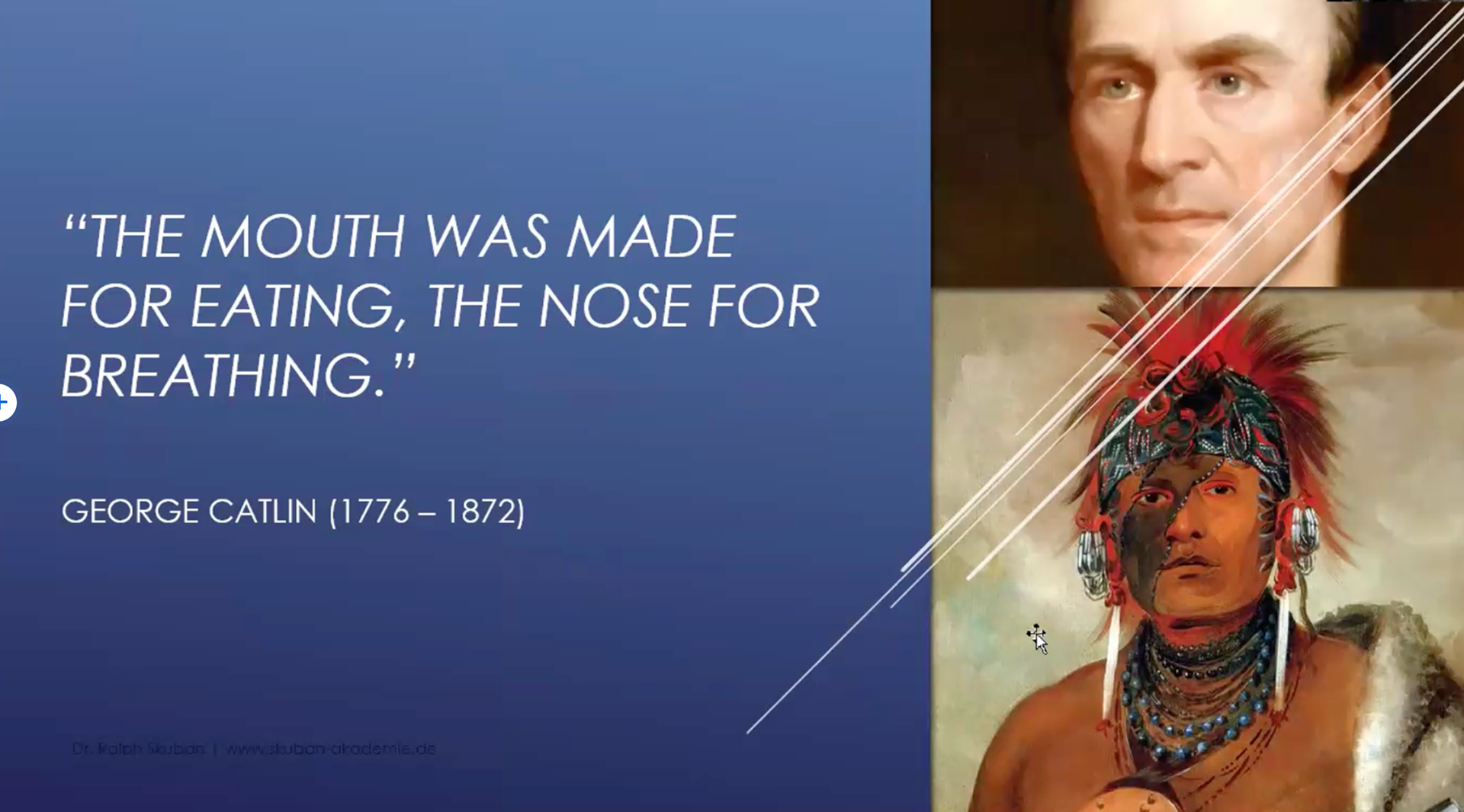
From 1830 onward, the talented portrait painter George Catlin visited around fifty tribes and documented their way of life.
From a very early age, Indigenous peoples teach their children to breathe through the nose rather than through the mouth.
From a very early age, Indigenous peoples teach their children to breathe through the nose rather than through the mouth.
Please don’t inhale through your mouth!
Maybe you also know this saying from my childhood:
"Close your mouth, there’s a draft!"
Maybe you also know this saying from my childhood:
"Close your mouth, there’s a draft!"
Just as a cold draft can make us sick, mouth breathing can harm our health.
While the nose regulates, filters, moistens, and warms the incoming air, the mouth—like a wide-open barn door—lets everything in without control.
While the nose regulates, filters, moistens, and warms the incoming air, the mouth—like a wide-open barn door—lets everything in without control.
The advantages of nasal breathing are exactly the disadvantages of mouth breathing.
If you don’t use your nose to breathe, it can become congested.
If you don’t use your nose to breathe, it can become congested.
Exhaling through the mouth, however, can be quite healthy.
Do you like to sing a lot? Keep it up! Singing increases lung capacity and promotes a steady, gentle airflow during exhalation.
But even then, it’s best to inhale through the nose.
Do you like to sing a lot? Keep it up! Singing increases lung capacity and promotes a steady, gentle airflow during exhalation.
But even then, it’s best to inhale through the nose.
When mouth breathing becomes a habit, the body takes in too much oxygen, and the brain gets used to it — encouraging even more mouth breathing to take in what it perceives as “necessary” extra oxygen.
With exclusive mouth breathing, the tongue’s natural impulse is lost — it no longer rests on the palate but drops down into the lower jaw.
This reduces ventilation of the Eustachian tube, which can affect hearing, narrows the airways, and causes the head to tilt backward to compensate for the restricted airflow.
This reduces ventilation of the Eustachian tube, which can affect hearing, narrows the airways, and causes the head to tilt backward to compensate for the restricted airflow.
This posture leads to tension in the spine, neck, and shoulders.
The ancient Greeks drew the spine as a “J”. Today, we draw it as an “S” — shaped in part by chronic mouth breathing.
In this compensatory posture, the weight of the tilted head presses on the back muscles, often causing pain.
The bend in the neck and upper spine can also put pressure on the brainstem, potentially causing headaches or even neurological problems.
The ancient Greeks drew the spine as a “J”. Today, we draw it as an “S” — shaped in part by chronic mouth breathing.
In this compensatory posture, the weight of the tilted head presses on the back muscles, often causing pain.
The bend in the neck and upper spine can also put pressure on the brainstem, potentially causing headaches or even neurological problems.
The tongue is a strong muscle — and it can help!
There are specific exercises for it in holistic facial yoga (I’ll just mention that here briefly).
There are specific exercises for it in holistic facial yoga (I’ll just mention that here briefly).
Mindfulness is the first step — becoming aware of whether, when, and how often you breathe through your mouth.
The second step is to let it go and gradually breathe more and more through your nose.
It may take time, but once you’ve taken the first step, you’re already on your way.
The second step is to let it go and gradually breathe more and more through your nose.
It may take time, but once you’ve taken the first step, you’re already on your way.
You can gently tape your mouth closed at night to help it stay shut while you sleep.
Use a medical-grade tape — I use a kinesiology tape because it’s skin-friendly.
I fold the ends over slightly so I can remove it easily, and I only place a small strip across the center of my lips.
Give it a try if you like!
Use a medical-grade tape — I use a kinesiology tape because it’s skin-friendly.
I fold the ends over slightly so I can remove it easily, and I only place a small strip across the center of my lips.
Give it a try if you like!
Finally, gift yourself your brightest, most radiant smile and thank yourself for taking this time — for you and your health.😃🙏

Breathing through the mouth can also be healthy: 🥱 Yawning
Yawning is a natural reflex — in humans as well as in animals.
It occurs in various emotional states:
when tired, bored, stressed, tense, embarrassed, hungry, concentration and more.
Yawning is a natural reflex — in humans as well as in animals.
It occurs in various emotional states:
when tired, bored, stressed, tense, embarrassed, hungry, concentration and more.
In Face Yoga, yawning is even practiced consciously:
🌀 It stretches many facial muscles,
🧘♀️ relaxes the face and mind, and
😊 can lift your mood.
🌀 It stretches many facial muscles,
🧘♀️ relaxes the face and mind, and
😊 can lift your mood.
Yawning is a deep inhale and exhale.
The cooler airflow during yawning can even help lower body temperature slightly ❄️.
The cooler airflow during yawning can even help lower body temperature slightly ❄️.
🏃 Runners often yawn right before the starting gun at sports competitions.
🎭 People also yawn before a performance or presentation.
🎭 People also yawn before a performance or presentation.
Yawning often appears in the evening as we grow tired.
Good oxygen supply then supports falling asleep 😴.
Good oxygen supply then supports falling asleep 😴.
🥱 And: yawning is contagious!
Especially empathetic people yawn faster in response —
and the closer our relationship to the yawner,
the more likely we are to catch the reflex 💞.
Especially empathetic people yawn faster in response —
and the closer our relationship to the yawner,
the more likely we are to catch the reflex 💞.
👉 Don’t suppress yawning or sighing —
they are natural ways the body regulates and relaxes.
they are natural ways the body regulates and relaxes.
Unless you’re yawning and sighing constantly. If that’s the case, observe when it happens — you might discover the reason yourself.
(Our dog Lea on the coast of Provence) 🐶🌊🇫🇷
Diaphragmatic breathing is our basic form of breathing. Babies breathe almost exclusively this way.
When inhaling, the belly expands and the diaphragm moves downward.
When exhaling, the belly contracts and the diaphragm moves upward.
The diaphragm is a dome-shaped muscle located just above the ribcage. It "guides" oxygen into the body and carbon dioxide out.
When inhaling, the belly expands and the diaphragm moves downward.
When exhaling, the belly contracts and the diaphragm moves upward.
The diaphragm is a dome-shaped muscle located just above the ribcage. It "guides" oxygen into the body and carbon dioxide out.
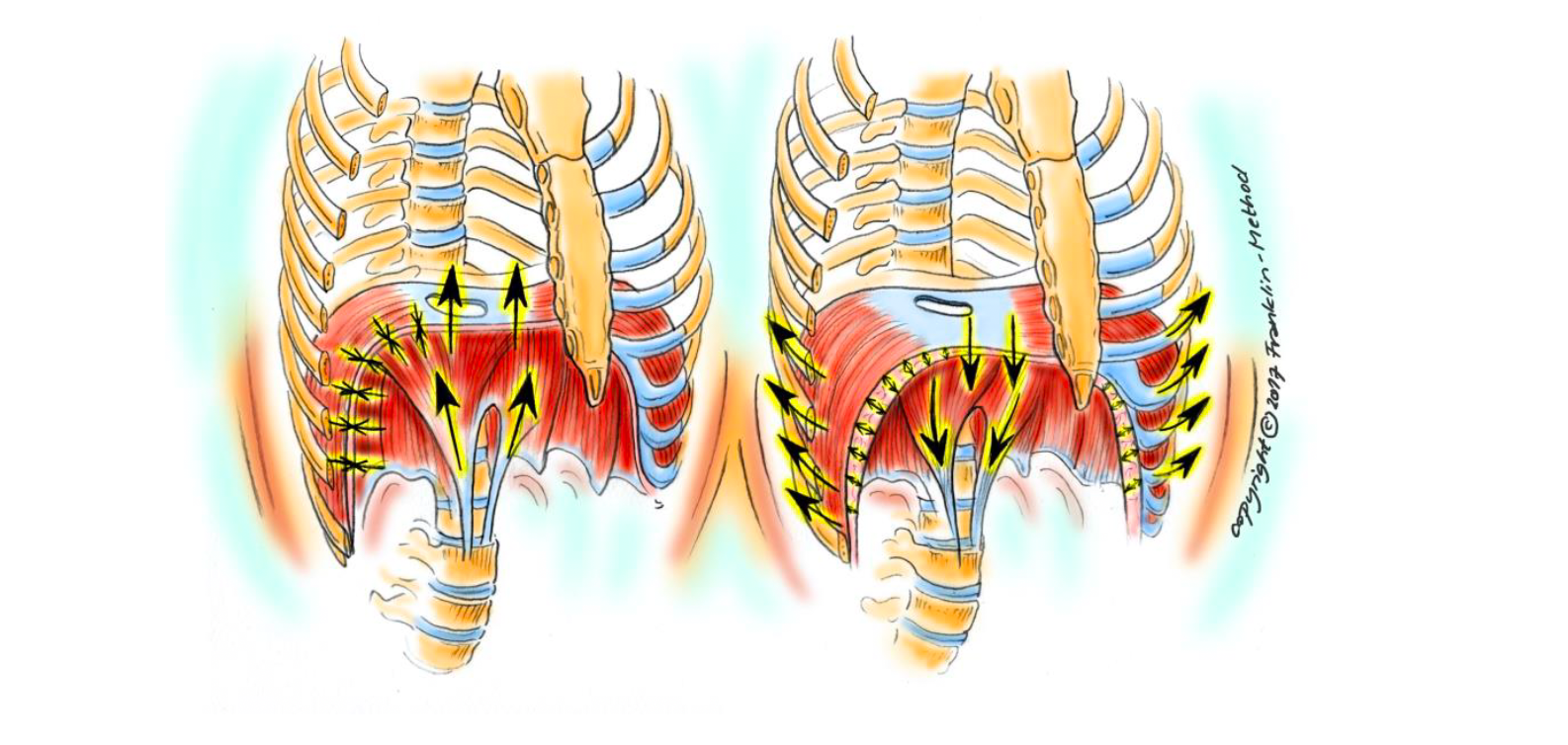
This beautiful image from the Franklin Method shows how the diaphragm lengthens during inhalation and shortens during exhalation.
Your diaphragm also enjoys a good side rib stretch:
As you inhale, lift your right arm upward, and as you exhale, stretch it to the left side. This movement stretches the muscles between your ribs.
Can you feel your ribs expanding like a fan?
Perhaps you can also sense how this exercise creates more space in your chest?
Your diaphragm also enjoys a good side rib stretch:
As you inhale, lift your right arm upward, and as you exhale, stretch it to the left side. This movement stretches the muscles between your ribs.
Can you feel your ribs expanding like a fan?
Perhaps you can also sense how this exercise creates more space in your chest?
🐝 Bhramari – The Bee Breath 🌬️
Bhramari is a yogic breathing technique in which a gentle humming sound is produced during exhalation.
Begin by inhaling slowly through your nose. As you exhale, keep your lips gently closed and create a smooth, steady humming sound.
Notice the vibration throughout your facial bones, sinuses, throat, and chest. Keep your jaw relaxed, your lips lightly touching, and your tongue resting comfortably on the floor of your mouth to allow efficient sound resonance.
The humming vibration creates gentle oscillations within the upper airway that may:
enhance awareness of breath and vocal resonance,
promote relaxation of the jaw, facial muscles, tongue, and soft palate,
encourage slower, longer exhalations,
support efficient breathing patterns,
increase nitric oxide production within the nasal passages, which may contribute to healthy nasal function,
stimulate the parasympathetic nervous system, promoting a state of calm and relaxation.
Many practitioners also experience improved vocal clarity and a greater sense of ease in the throat after practicing Bhramari.
✨ Variations
Variation 1 – Resonant Inhalation
Inhale with a gentle snoring sound, then hum during the exhalation. This combination can increase awareness of airflow and vocal resonance while helping prepare the voice.
Inhale with a gentle snoring sound, then hum during the exhalation. This combination can increase awareness of airflow and vocal resonance while helping prepare the voice.
Variation 2 – Internal Listening
Lightly close your eyes and ears with your fingertips while humming. Reducing external sound enhances bone conduction and makes the internal vibration easier to perceive.
Lightly close your eyes and ears with your fingertips while humming. Reducing external sound enhances bone conduction and makes the internal vibration easier to perceive.
Variation 3 – Exploring Resonance
Allow subtle movements of your head and nose while maintaining the hum. Observe how changes in head position influence resonance, vibration, and sound quality.
Allow subtle movements of your head and nose while maintaining the hum. Observe how changes in head position influence resonance, vibration, and sound quality.
💜 Practicing outdoors—especially among flowering lavender with the gentle sound of bees—can add a rich sensory dimension to the experience, inviting deeper presence and connection with nature.
Alternate Nostril Breathing (Nadi Shodhana)
Alternate nostril breathing is a pranayama breathing exercise to harmonize the right and left sides of your body. It can help keep—or restore—balance between the two energy channels in the body: the left side (moon, emotions) and the right side (sun, mind).
As with all breathing practices, don’t push yourself. Listen to your body rather than strictly following instructions. These are only meant as guidance, ideas, and inspiration.
Connect with yourself and feel which rhythm—and whether or not any breath retention—feels good for you here and now. (Some yogis even faint during alternate nostril breathing because they follow instructions instead of listening to themselves.)
Connect with yourself and feel which rhythm—and whether or not any breath retention—feels good for you here and now. (Some yogis even faint during alternate nostril breathing because they follow instructions instead of listening to themselves.)
Every day is different. Don’t compare yourself to yesterday or to others. Breathe in the rhythm that feels exactly right in this moment. Listen to your body—it knows. No one else does.
Preparation
Close your eyes, relax your face, and bring your attention to your breath.
Take a few calm breaths in and out through your nose.
Hand position (optional)
Vishnu Mudra: gently fold the index and middle fingers; keep the thumb and ring finger active.
The Practice
One round of breathing consists of two breaths.
Always begin by inhaling through the left nostril and end by exhaling through the left nostril.
Always begin by inhaling through the left nostril and end by exhaling through the left nostril.
Close the right nostril with your thumb.
➤ Inhale through the left nostril.
➤ Inhale through the left nostril.
Close the left nostril with your ring finger, open the right.
➤ Exhale through the right nostril.
➤ Exhale through the right nostril.
Inhale through the right nostril.
Close the right, open the left.
➤ Exhale through the left nostril. 🌬️
➤ Exhale through the left nostril. 🌬️
Continue in this alternating way—calm, steady, and even.
For example, practice 5 rounds or about 2 minutes. Feel into yourself and let your body tell you how long this practice feels good today.
For example, practice 5 rounds or about 2 minutes. Feel into yourself and let your body tell you how long this practice feels good today.
Always finish with an exhale through the left nostril, then take a few mindful breaths afterward.
Each breath is allowed to follow its own natural rhythm.
Optional breathing rhythms
You may also experiment with counted rhythms, for example:
Without breath retention:
4 : 0 : 8
(4 seconds inhale : 0 seconds hold : 8 seconds exhale)
4 : 0 : 8
(4 seconds inhale : 0 seconds hold : 8 seconds exhale)
With breath retention:
4 : 8 : 8 : 8
(4 seconds inhale : 8 seconds hold after inhale :
8 seconds slow, even exhale : 8 seconds hold after exhale)
4 : 8 : 8 : 8
(4 seconds inhale : 8 seconds hold after inhale :
8 seconds slow, even exhale : 8 seconds hold after exhale)
Tips 💡
Do not hold the breath if it feels uncomfortable.
The breath should be gentle, smooth, and effortless.
Try alternate nostril breathing as an evening ritual before sleep. 💫